
Pinealon 20mg
$70.00
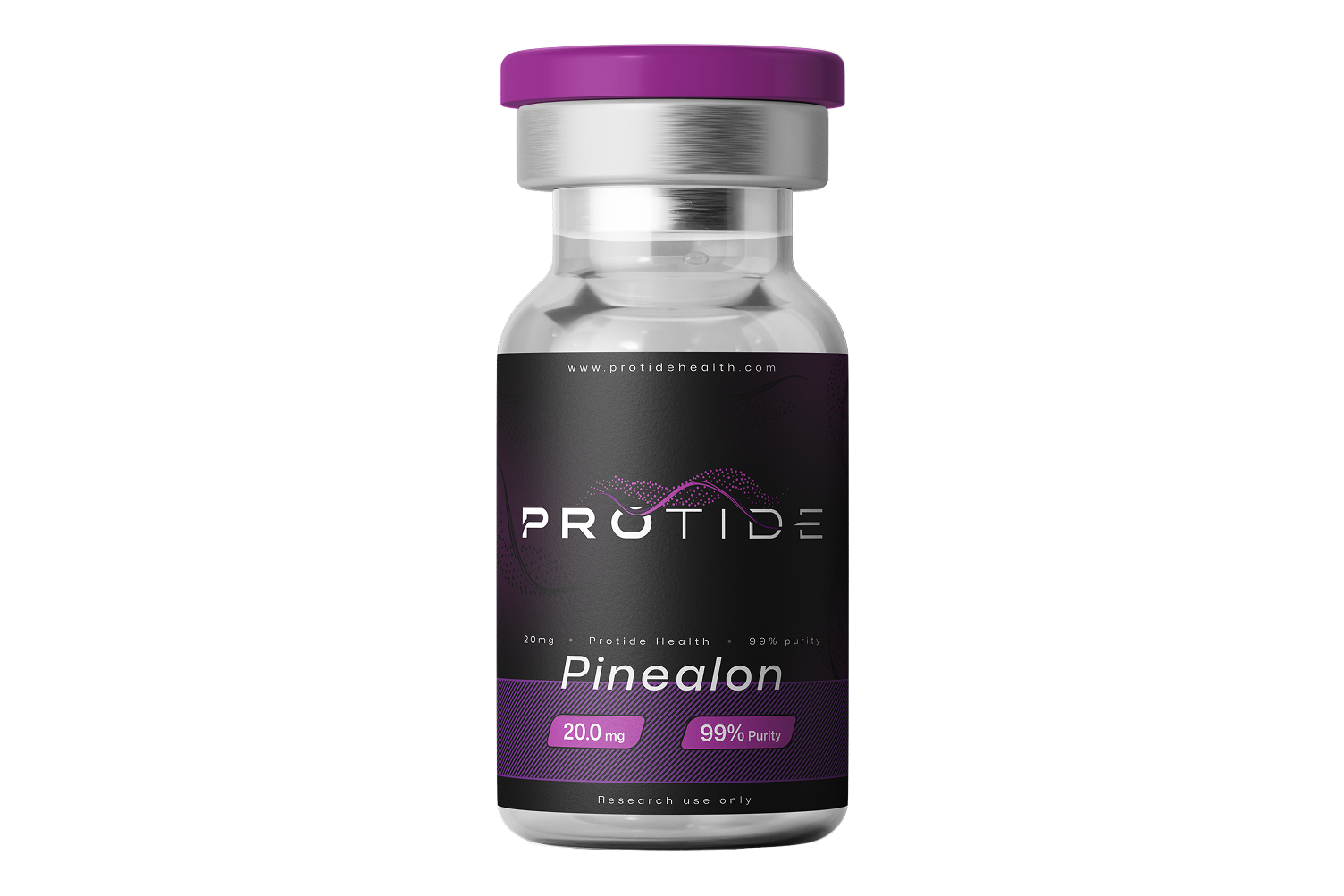
Pinealon 20mg product shot featuring a professionally labeled Protide Health 3mL research vial containing white to off-white lyophilized Glu-Asp-Arg material, with the 20mg strength, EDR peptide identity, and research-use-only labeling clearly displayed against a clean laboratory-style background.


Pinealon 20mg – Protide Health USA
Pinealon Overview & Technical Specifications
Pinealon is a synthetic tripeptide composed of three amino acids in the sequence:
Glu-Asp-Arg
The abbreviated sequence is:
EDR
Its chemically defined form is represented as:
H-Glu-Asp-Arg-OH
The supplied Pinealon PubChem chemical record identifies the compound as PubChem CID 10273502, CAS 175175-23-2, molecular formula C15H26N6O8, and molecular weight approximately 418.40 g/mol.
Protide Health supplies Pinealon as 20mg of 99% purity lyophilized research material in a 3mL vial for controlled biochemical, cellular, molecular, analytical, and qualified preclinical experimentation.
Technical Specifications
- Product Name: Pinealon
- Alternative Names: EDR Peptide, EDR, Glu-Asp-Arg
- Quantity: 20mg
- Form: Lyophilized powder
- Vial Size: 3mL
- Purity: 99%
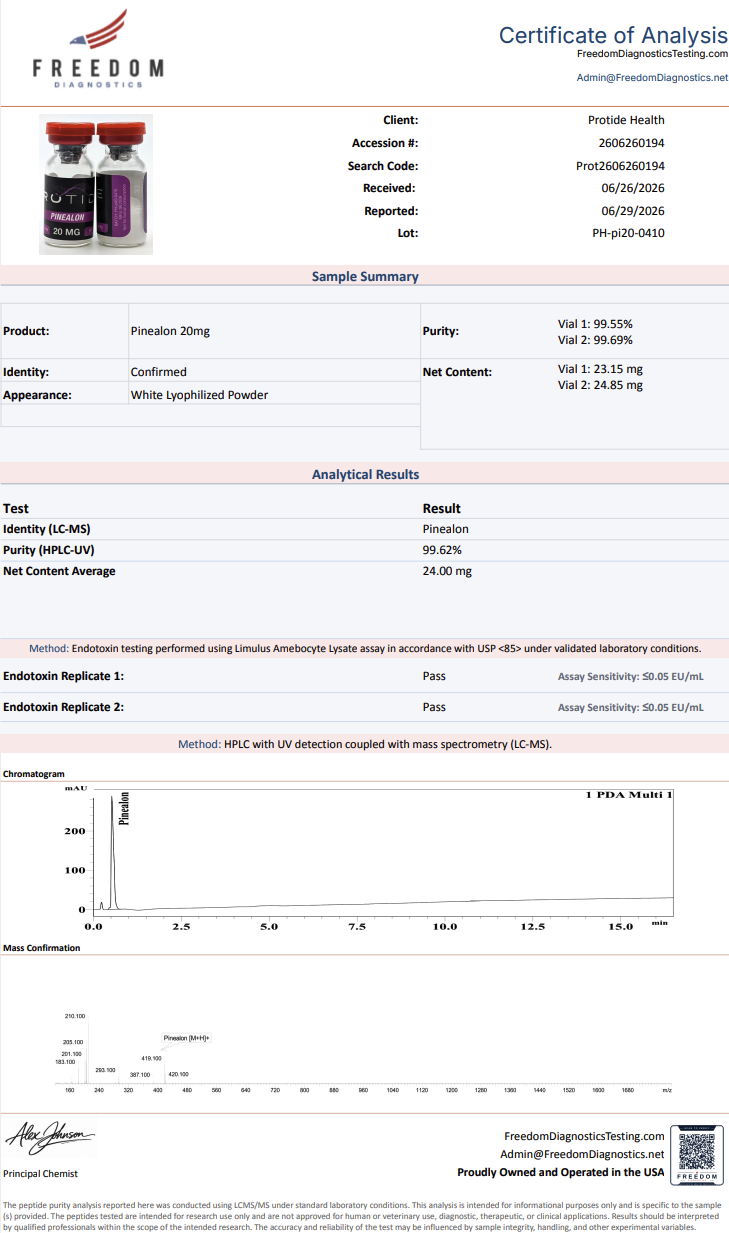
- Testing: HPLC-MS verified; third-party tested
- Peptide Type: Synthetic tripeptide
- Peptide Length: 3 amino acids
- Sequence: Glu-Asp-Arg
- Abbreviated Sequence: EDR
- CAS Number: 175175-23-2
- PubChem CID: 10273502
- Molecular Formula: C15H26N6O8
- Molecular Weight: Approximately 418.40 g/mol
- Appearance: White to off-white lyophilized powder
- Solubility: Soluble in water
- Storage: Store sealed at ≤6°C and protected from heat, light, and moisture
- Research Use: Biochemical, cellular, molecular, analytical, and qualified preclinical research only
Pinealon Peptide Research Context
Pinealon belongs to a group of short regulatory peptides studied in experimental neurobiology and molecular signaling.
Published research generally refers to the compound as Glu-Asp-Arg or the EDR peptide.
Experimental work has examined EDR in relation to:
- Oxidative-stress responses
- Reactive oxygen species
- Neuronal cell viability
- ERK1/2 signaling
- Gene-expression regulation
- DNA interaction
- Serotonin-associated pathways
- Apoptosis-related proteins
- Antioxidant enzyme expression
- Dendritic-spine models
Researchers can review broader Pinealon and EDR peptide literature indexed by PubMed for peer-reviewed studies involving the tripeptide.
Preclinical Research Applications
Oxidative-Stress Research
One of the better-characterized experimental areas for Pinealon involves cellular oxidative stress.
A published study examined Glu-Asp-Arg in:
- Cerebellar granule cells
- Neutrophils
- PC12 cells
Under experimentally induced oxidative stress, researchers reported changes in reactive oxygen species accumulation and cell viability.
The study also examined ERK1/2 signaling and cell-cycle-related responses.
These findings were generated in laboratory cell systems and should not be interpreted as evidence of therapeutic neuroprotection in humans.
ERK1/2 & Cellular Signaling Research
ERK1/2 proteins belong to the mitogen-activated protein kinase signaling network.
Experimental Pinealon research has reported changes in the timing of ERK1/2 activation under oxidative-stress conditions.
MAPK/ERK pathways are involved in many cellular processes, including:
- Gene expression
- Cell survival
- Differentiation
- Stress responses
- Proliferative signaling
The exact relationship between the EDR peptide and these pathways remains dependent on cell type and experimental conditions.
DNA Interaction Research
Physical-chemistry studies have investigated direct interactions between Glu-Asp-Arg and DNA.
Spectroscopy, NMR, viscosimetry, and molecular-dynamics approaches have suggested that EDR can interact with DNA and may partially enter the major groove.
Experimental work has specifically examined interactions involving guanine-associated atoms and the effects of sodium and magnesium ions on peptide-DNA binding.
This provides a mechanistic basis for studying Pinealon in molecular-recognition and peptide–nucleic-acid experiments.
It does not establish that the peptide universally regulates gene expression in intact organisms.
Gene-Expression Research
A 2020 review discussed proposed mechanisms by which EDR may influence gene expression and protein synthesis.
The literature summarized experimental pathways involving:
- Caspase-3
- p53
- SOD2
- GPX1
- PPARA
- PPARG
- MAPK/ERK signaling
- Calmodulin-associated systems
- Serotonin-related pathways
Several of these mechanisms remain proposed or model-dependent rather than fully established causal pathways.
Accordingly, Pinealon should be evaluated through clearly defined molecular endpoints rather than broad neurological claims.
Serotonin-Expression Research
Research in aging rat cerebral-cortex cell cultures has examined Glu-Asp-Arg in relation to serotonin-associated molecular pathways.
One study reported changes in serotonin expression and used molecular docking to investigate potential interactions involving the gene encoding tryptophan hydroxylase.
These findings concern a controlled experimental model and do not establish mood, psychiatric, cognitive, or behavioral effects in humans.
Hypoxia-Related Experimental Models
Short regulatory peptides, including EDR, have also been investigated in animal models of hypoxic stress.
Experimental studies have evaluated endpoints such as:
- Oxidative stress
- Neuronal resistance
- Reactive oxygen species
- Antioxidant enzyme systems
- Behavioral measurements
- Learning-related endpoints in rodents
These findings remain preclinical.
They do not establish clinical protection against hypoxia, neurological disease, or cognitive decline.
What Is Pinealon Peptide?
The search phrase what is pinealon peptide refers to the synthetic tripeptide Glu-Asp-Arg.
Its sequence is:
Glu-Asp-Arg (EDR)
Unlike larger receptor-targeting peptides, EDR contains only three amino-acid residues.
Scientific interest in the molecule centers primarily on short-peptide interactions with cellular signaling, oxidative-stress pathways, nucleic acids, and gene-expression models.
Pinealon Peptides & Short Regulatory Peptide Research
The phrase pinealon peptides generally refers to EDR within the broader category of short regulatory peptides.
Short peptides can differ significantly in:
- Amino-acid sequence
- Charge
- Molecular weight
- Protein interactions
- DNA or RNA interactions
- Cellular localization
- Experimental activity
Findings involving one short peptide should therefore not automatically be applied to another.
Pinealon should be evaluated specifically as the EDR sequence rather than generalized from studies on unrelated peptide bioregulators.
Pinealon Peptide Buy: Research Sourcing Context
The search phrase pinealon peptide buy has transactional intent, but laboratory sourcing should focus on verifiable analytical characteristics rather than human-use claims.
Relevant research-material considerations include:
- Defined chemical identity
- Correct EDR sequence
- Verified purity
- Analytical testing
- Lot traceability
- Appropriate laboratory packaging
- Defined storage specifications
Protide Health specifies this material as 99% purity, HPLC-MS verified, third-party tested Pinealon supplied in a 3mL research vial.
The product is not marketed for personal, clinical, or therapeutic use.
Pinealon Peptide Protocol Searches
The phrase pinealon peptide protocol can refer to either laboratory methodology or human administration.
Protide Health does not provide human dosing, injection schedules, treatment cycles, administration routes, or clinical protocols.
For legitimate laboratory research, experimental conditions should be established according to:
- The specific assay
- Cell type or biochemical model
- Institutional protocols
- Validated experimental controls
- Research objectives
- Appropriate concentration-response design
The stated 20mg refers only to the amount of research material supplied in the vial.
It is not a recommended human dose.
Peptide Pinealon & Molecular Research
The search variation peptide pinealon refers to the same Glu-Asp-Arg compound.
Because EDR contains acidic glutamate and aspartate residues along with basic arginine, its charge state and interaction behavior can depend on experimental pH and ionic environment.
Research on peptide-DNA interactions has demonstrated that ionic conditions, including divalent magnesium ions, can influence observed binding behavior.
This makes assay conditions important when comparing molecular findings between studies.
Research Format & Storage
Protide Health supplies Pinealon as white to off-white lyophilized powder in a 3mL vial.
The available quantity is:
20mg
According to the supplied specifications:
- Store at ≤6°C
- Keep sealed
- Protect from heat
- Protect from direct light
- Protect from moisture
The product is specified as soluble in water.
These statements describe laboratory storage characteristics and are not administration instructions.
Research Limitations
The Pinealon evidence base requires careful interpretation.
Important limitations include:
- A substantial portion of the literature is preclinical.
- Many studies come from a relatively concentrated group of investigators.
- Cellular oxidative-stress findings do not establish clinical neuroprotection.
- DNA-binding observations do not establish broad gene regulation in humans.
- Molecular-docking findings are hypothesis-generating rather than direct biological proof.
- Rodent cognition findings cannot establish human cognitive effects.
- Animal hypoxia models cannot establish equivalent human effects.
- Evidence involving related short peptides should not automatically be attributed to EDR.
- Human evidence is limited compared with the cellular and animal literature.
- The Protide Health research material has no established human safety or therapeutic profile.
For these reasons, Pinealon is supplied strictly for qualified laboratory research.
Literature & Citation Index
Pinealon Increases Cell Viability by Suppression of Free Radical Levels and Activating Proliferative Processes
Year: 2011
PMID: 21978084
DOI: 10.1089/rej.2011.1172
Research Context: Glu-Asp-Arg, reactive oxygen species, cerebellar granule cells, PC12 cells, cell viability, ERK1/2 activation, and cell-cycle-related research.
Role of Mono- and Divalent Ions in Peptide Glu-Asp-Arg-DNA Interaction
Journal: Journal of Physical Chemistry B
Year: 2019
PMID: 30762356
DOI: 10.1021/acs.jpcb.8b10359
Research Context: DNA interaction, spectroscopy, NMR, molecular dynamics, ionic conditions, and Glu-Asp-Arg binding behavior.
Short Peptides Stimulate Serotonin Expression in Cells of Brain Cortex
Year: 2014
PMID: 24909721
DOI: 10.1007/s10517-014-2496-y
Research Context: EDR, aging rat cerebral-cortex cultures, serotonin expression, tryptophan-hydroxylase-associated research, and molecular docking.
Investigation of Antihypoxic Properties of Short Peptides
Year: 2008
PMID: 18546825
Research Context: Pinealon and other short peptides in hypobaric-hypoxia models, oxidative-stress endpoints, antioxidant systems, and neuronal experimental responses.
EDR Peptide: Possible Mechanism of Gene Expression and Protein Synthesis Regulation Involved in the Pathogenesis of Alzheimer’s Disease
Journal: Molecules
Year: 2020
PMID: 33396470
DOI: 10.3390/molecules26010159
Research Context: Review of EDR research involving gene expression, MAPK/ERK signaling, apoptosis-related proteins, antioxidant enzymes, dendritic-spine models, and proposed peptide–nucleic-acid interactions.
Related Protide Health Research Products
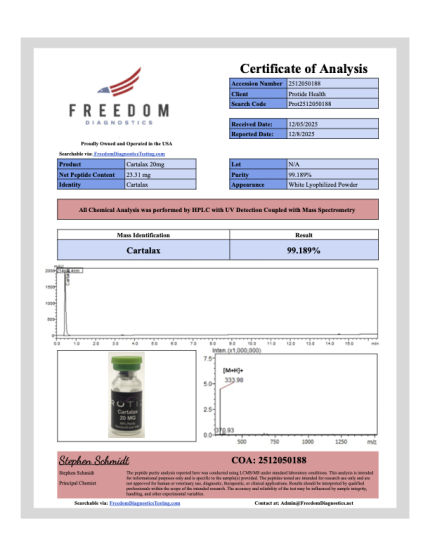
Researchers comparing short peptide systems may review Cartalax 20mg for a chemically distinct peptide research model.
The Vesugen 20mg research peptide provides another short-sequence peptide for comparative molecular and cellular experiments.
Researchers may also examine N-Acetyl Epithalon when comparing EDR with an N-terminally modified short peptide system.
These materials contain different amino-acid sequences and should not be considered chemically or mechanistically interchangeable.
Frequently Asked Questions
What is Pinealon?
Pinealon is a synthetic three-amino-acid peptide with the sequence Glu-Asp-Arg, abbreviated EDR.
What is Pinealon peptide?
The term Pinealon peptide refers to the Glu-Asp-Arg tripeptide. It is studied in laboratory models involving oxidative stress, gene expression, peptide-DNA interactions, and neuronal cell systems.
What is the Pinealon sequence?
The sequence is:
Glu-Asp-Arg
or:
EDR
What is the molecular formula of Pinealon?
The verified molecular formula is C15H26N6O8, with molecular weight approximately 418.40 g/mol.
What is the CAS number for Pinealon?
The verified CAS number is 175175-23-2.
What is the PubChem CID?
The verified PubChem identifier is CID 10273502.
What does Pinealon research investigate?
Published studies have investigated oxidative-stress responses, reactive oxygen species, neuronal cell viability, ERK signaling, DNA interactions, serotonin-associated pathways, gene-expression models, and animal hypoxia systems.
Is Pinealon proven to improve cognition in humans?
No. The strongest mechanistic evidence is primarily cellular and animal based, and existing human evidence is limited. The Protide Health product is not supplied for cognitive enhancement or treatment.
What is a Pinealon peptide protocol?
There is no human-use protocol provided for this product. Laboratory researchers should develop experimental protocols according to their validated assay design and institutional requirements.
What purity does Protide Health specify?
Protide Health specifies 99% purity, with HPLC-MS verification and third-party testing.
What form is Pinealon supplied in?
Pinealon is supplied as 20mg of white to off-white lyophilized research material in a 3mL vial.
Is Pinealon intended for human use?
No. It is supplied exclusively for biochemical, cellular, molecular, analytical, in-vitro, and qualified preclinical research.
Laboratory Terms & Compliance
Laboratory Research Use Only
This product is supplied exclusively for laboratory research, analytical testing, in-vitro studies, preclinical research, and qualified scientific experimentation.
It is not intended for human or veterinary consumption, medical use, diagnostic use, therapeutic use, cognitive enhancement, neurological treatment, anti-aging treatment, or clinical administration.
No human dosage, injection schedule, administration route, treatment protocol, cycle, or preparation instructions are provided.
The purchaser is responsible for appropriate laboratory handling, storage, and use under applicable institutional, federal, state, and local requirements. Please review the Protide Health Terms & Conditions before purchasing.
For research use only.


MAECENAS IACULIS
Vestibulum curae torquent diam diam commodo parturient penatibus nunc dui adipiscing convallis bulum parturient suspendisse parturient a.Parturient in parturient scelerisque nibh lectus quam a natoque adipiscing a vestibulum hendrerit et pharetra fames nunc natoque dui.
ADIPISCING CONVALLIS BULUM
- Vestibulum penatibus nunc dui adipiscing convallis bulum parturient suspendisse.
- Abitur parturient praesent lectus quam a natoque adipiscing a vestibulum hendre.
- Diam parturient dictumst parturient scelerisque nibh lectus.
Scelerisque adipiscing bibendum sem vestibulum et in a a a purus lectus faucibus lobortis tincidunt purus lectus nisl class eros.Condimentum a et ullamcorper dictumst mus et tristique elementum nam inceptos hac parturient scelerisque vestibulum amet elit ut volutpat.
Related products
Reviews
There are no reviews yet.